Worldbuilding, without losing track of it.

What a fictional world is made of, how much of it you need before you write, and the worldbuilding tools that keep it straight.

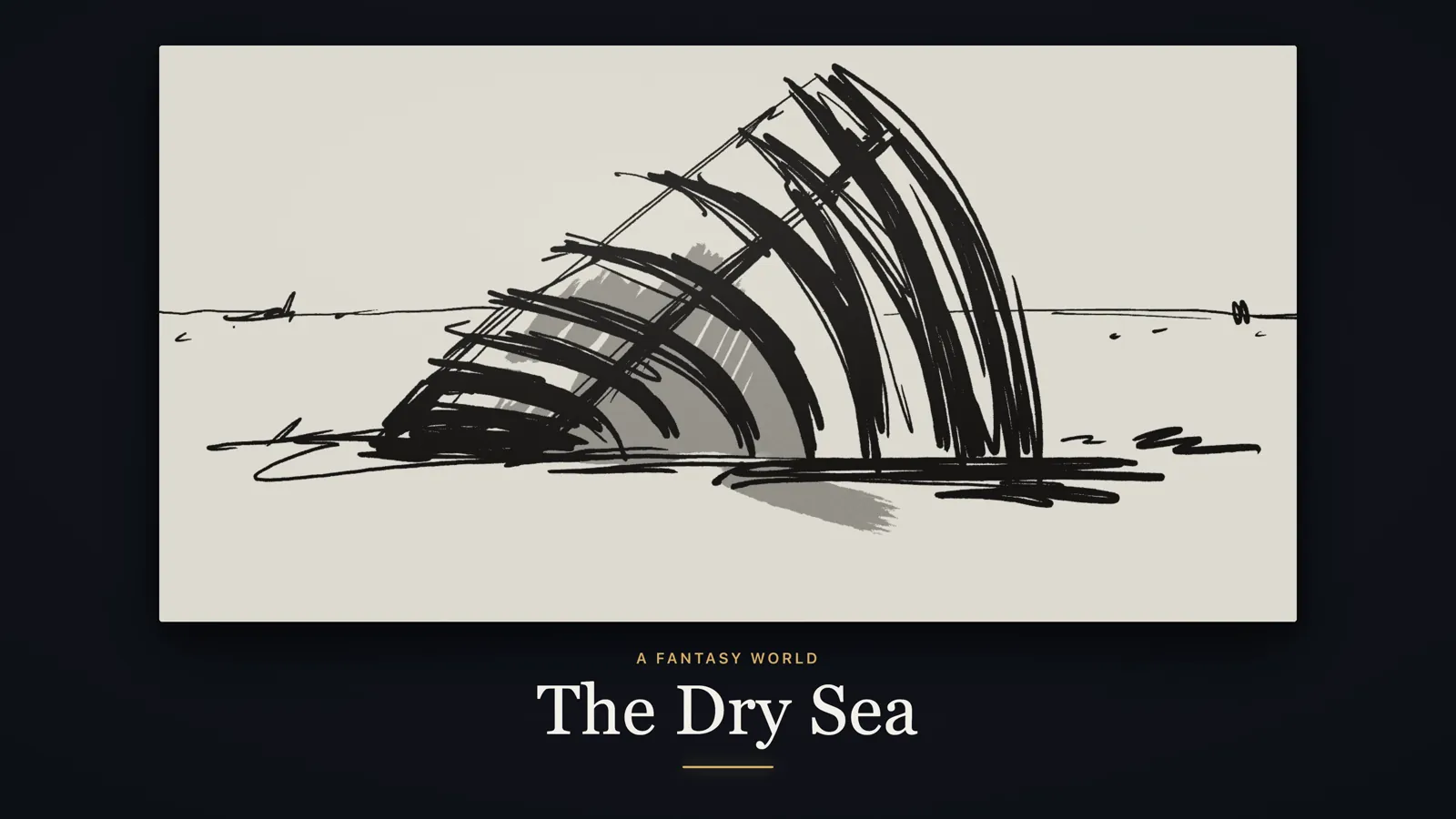
An ink drawing of a wrecked ship’s ribs on a white plain, from the demo world The Dry Sea
The video is coming soon

One world, built in BYOK Studio’s wiki: the Dry Sea.

What is worldbuilding?

Worldbuilding is inventing the place a story happens in: its land, history, peoples, powers and rules. Fantasy and science fiction lean on it most, but game masters, screenwriters and anyone writing a long series do the same work.

Readers only see a little of it. The tavern in chapter four feels solid because you know who owns it and which army drinks there, even if none of that reaches the page.

The trouble comes later. Every fact you invent is one more to remember, and a mistake in chapter nine is easy to miss when the fact it contradicts is in chapter two. So this page covers both halves: building a world, and keeping hold of it.

How to start worldbuilding: the map or the room

There are two honest answers to where a world begins, and most writers end up using both.

From the outside in

Start with the big frame, such as the map, the gods and the ages of history, and work down to a street. Tolkien built his languages first and wrote the stories to give them a world. Everything fits. The risk is never reaching chapter one.

From the inside out

Start with one person in one room, and invent only what the scene needs: what’s on the table, who’s owed money, why nobody will say the queen’s name. Everything you invent gets used. The risk is contradicting yourself thirty chapters later.

Most writers land in between. They fix a small frame, such as one rule, a rough map and the two or three powers that matter, and then build outwards from the scenes they write.

The Dry Sea, the demo world in the video above, started with three wiki entries: a clerk called Sums, a city called the Din, and one rule of magic. It has ninety-eight now, and it supplies the examples below.

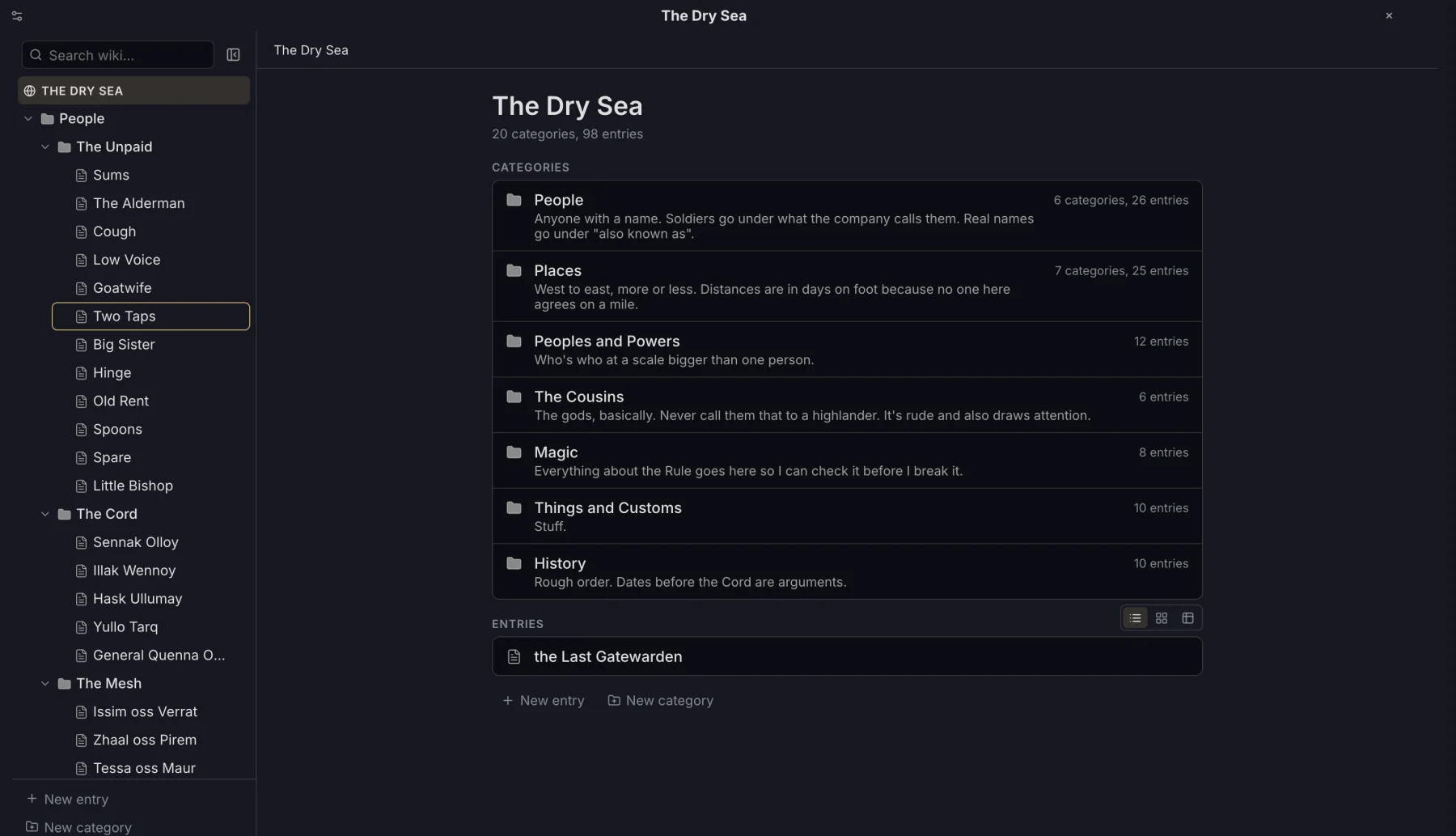
The front page of a worldbuilding wiki in BYOK Studio, listing categories for people, places, powers, gods, magic, customs and history
The Dry Sea’s wiki. Each category opens with a note to self.

What a fictional world is made of

Most fantasy worlds come down to six parts. You won’t need them all, and they don’t come in order.

One rule, and everything it costs

Most built worlds have one thing ours doesn’t: a magic, a technology, a strange piece of physics. What it can’t do matters more than what it can. A power with no limit solves every problem in the plot, and then there’s no plot. Brandon Sanderson makes the full case in his second law of magic.

So write the rule in one sentence and follow it outwards. Who gets rich from it? What would a careful person do to protect themselves? What stops it from running the world?

The Dry Sea’s rule is that if you hear a spell, you have to obey it. So soldiers wear earplugs, and armies give their orders by hand. Deaf soldiers are valuable, because magic can’t touch them. A city that keeps four hundred bells ringing can’t be attacked with it at all. And a spell only lasts until sunrise, which is what stops the rule from running everything.
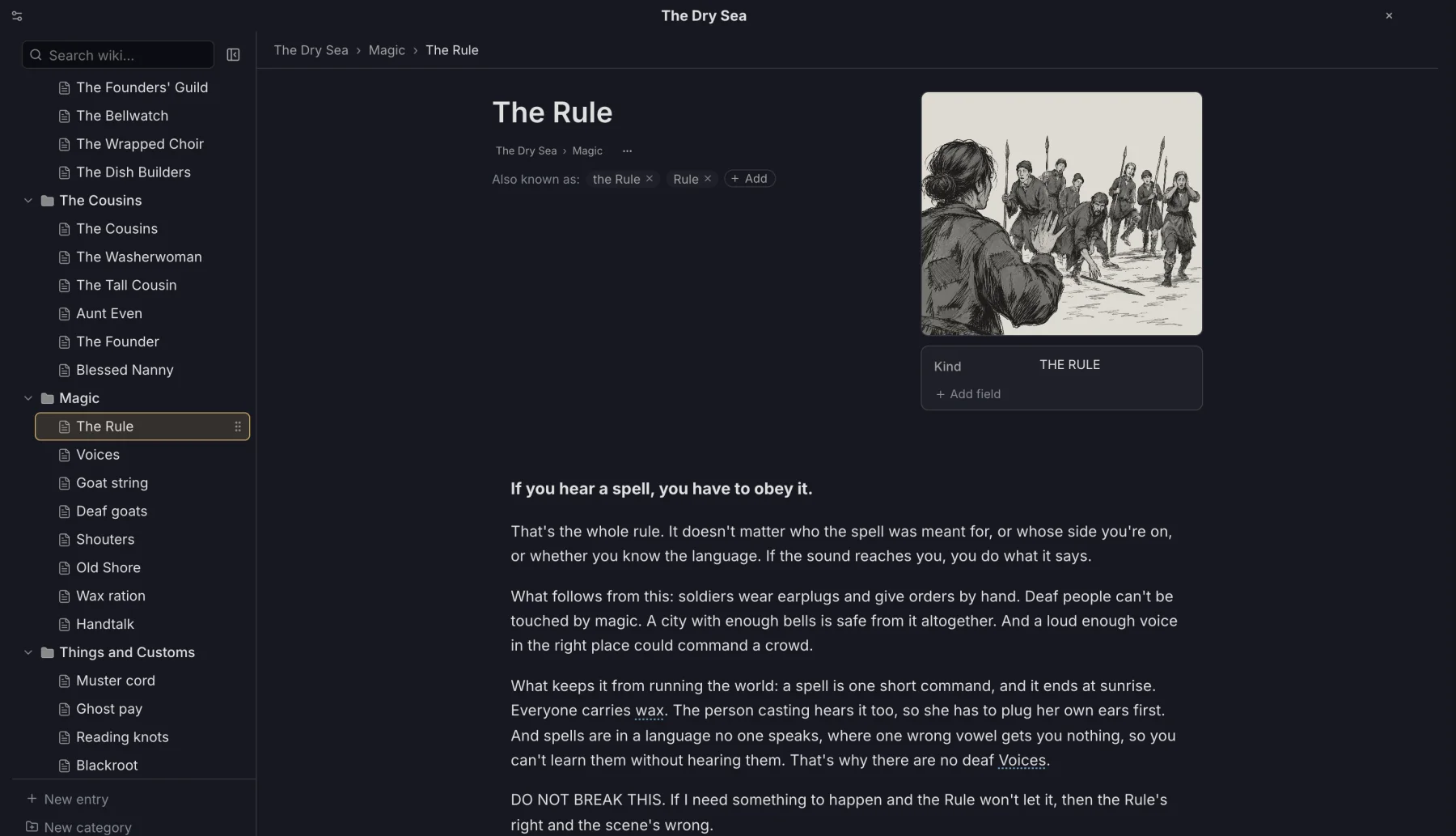
A wiki entry for a magic rule in BYOK Studio: the rule in one sentence, what follows from it, and what limits it
The rule, what follows from it and what limits it, in one entry.

Land that pushes people around

Geography decides who can reach whom, and how fast. Three rules of thumb keep a map believable. Rivers join on their way to the sea and almost never split. The far side of a mountain range is dry. And towns grow where travellers have to stop, such as a ford, a pass or a harbour.

Then measure the world in days. A person on foot covers a little under twenty miles a day, and a large army about ten. Two cities three hundred miles apart are two weeks from each other for a messenger and a month for an invasion, and that does more for a plot than a beautiful map.

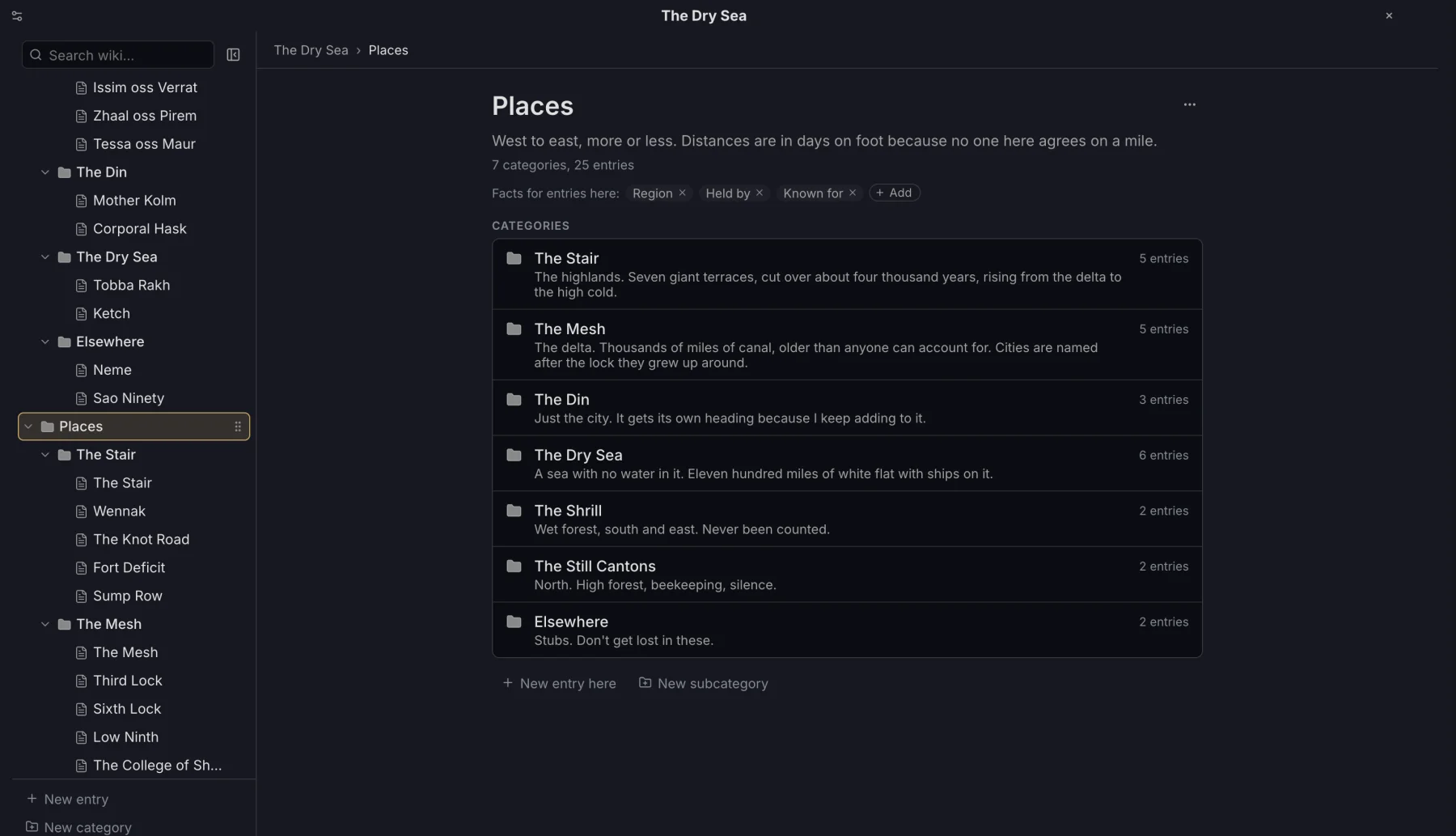
You don’t need to draw anything to begin. The Dry Sea’s places are a list, sorted west to east and measured in days on foot because, as the note on the category says, no one there agrees on a mile.

The Places category of a worldbuilding wiki, with regions listed west to east and the facts every place carries
Every place carries the same three facts: its region, who holds it and what it’s known for.

Who eats, and who pays

Invented worlds tend to be full of soldiers, wizards and thieves, with nobody growing the food. Before industry, eight or nine people in ten worked the land. You don’t have to show that, but it helps to know where the bread comes from, and what happens when it stops.

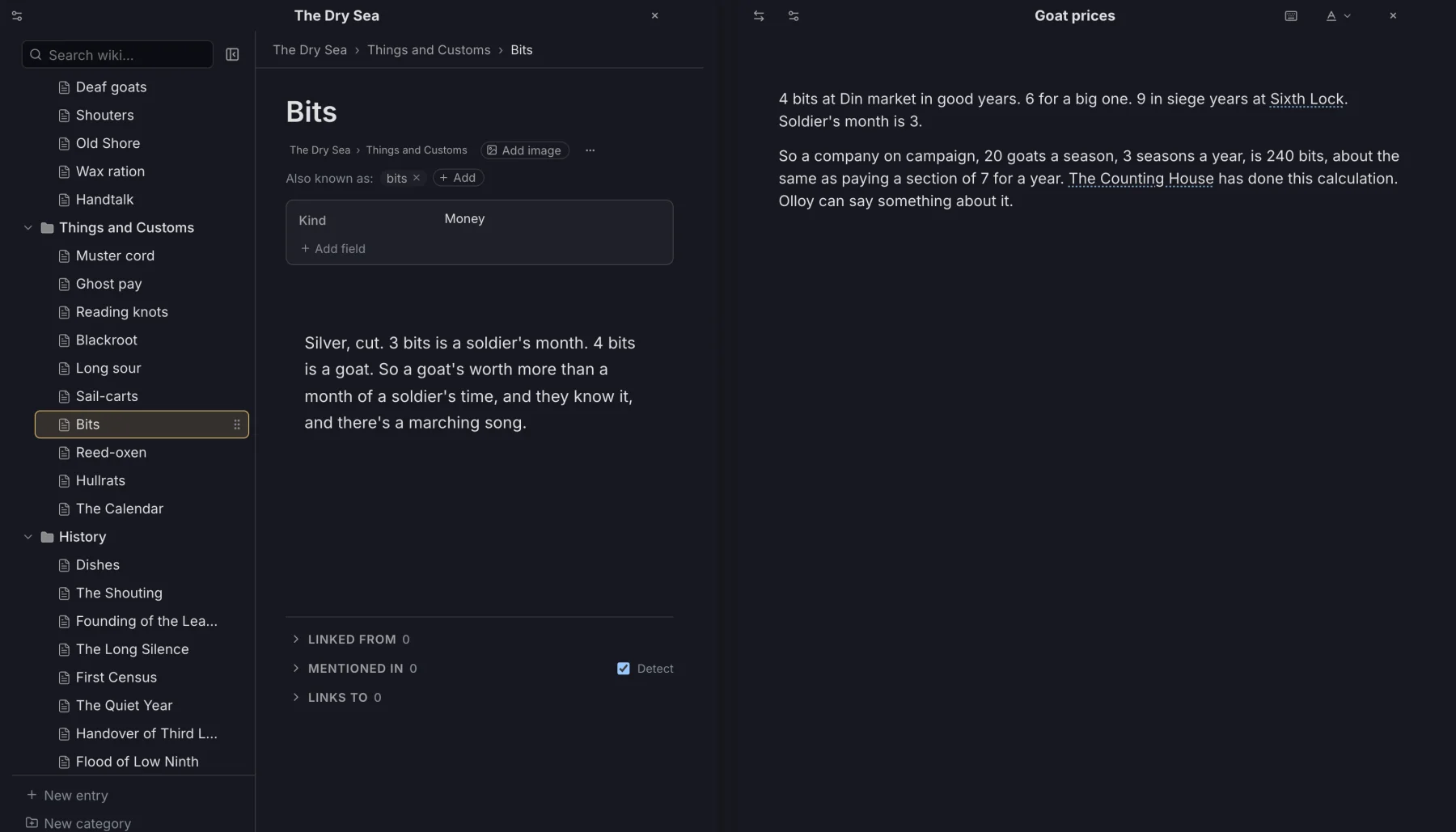
For prices, two numbers are enough: what a month of ordinary work pays, and what one everyday thing costs. In the Dry Sea a soldier earns three bits a month and a goat costs four. The soldiers know a goat is worth more than they are, and there’s a marching song about it.

A note on goat prices open beside the wiki entry for the world’s currency in BYOK Studio
A price note, open beside the entry for the currency.

More than one opinion per people

The most common weakness in invented cultures is one trait per people: the warrior people, the merchant people, the wise people in the forest. Real societies argue with themselves, so give each one something its members disagree about.

Customs come more easily once you know the pressure behind them. People with little water have rules about water. People living under a magic that works by sound have rules about noise.

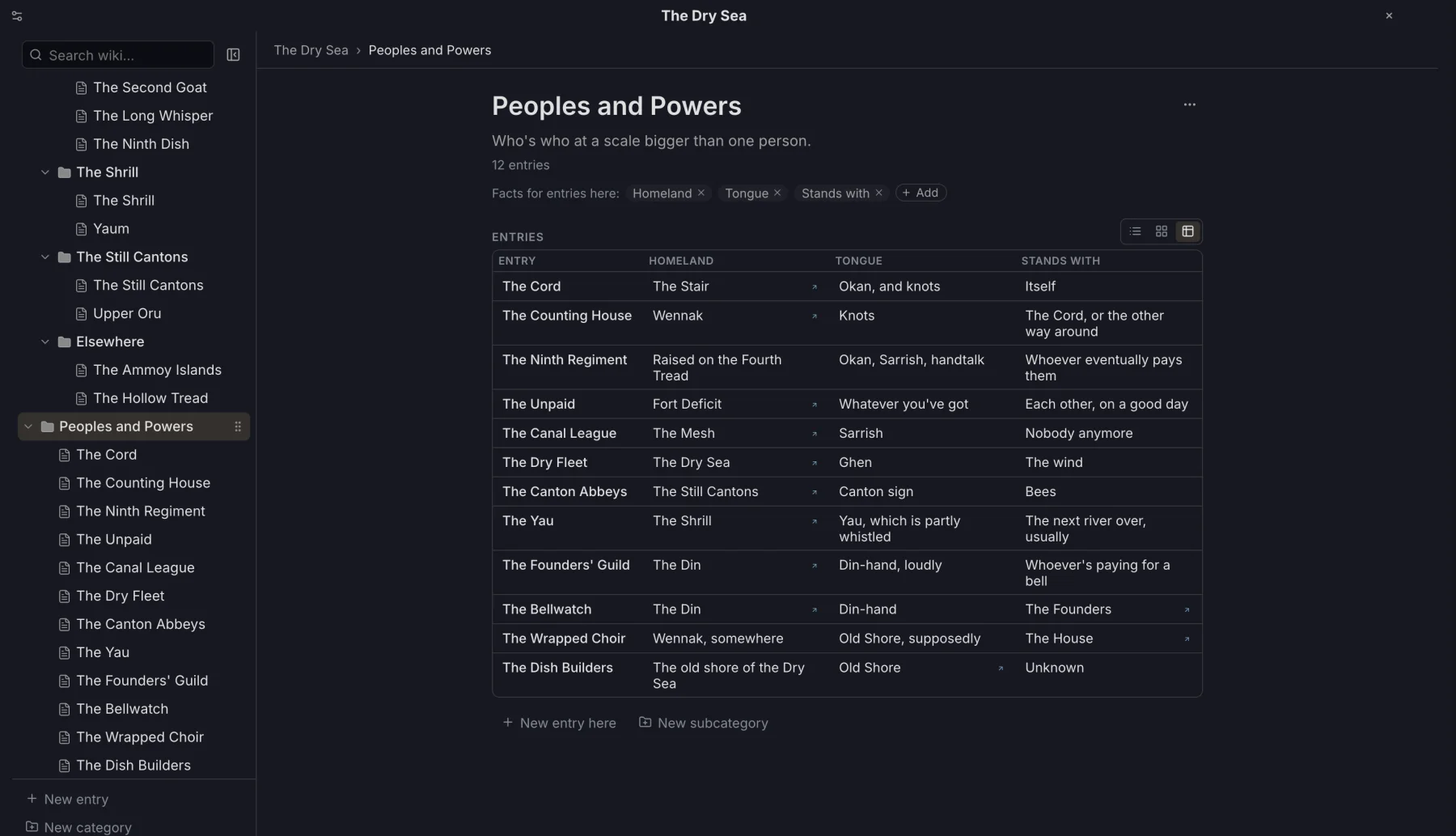
For whole powers, three facts go a long way: where they’re from, what they speak and whose side they’re on. In the Dry Sea, the Ninth Regiment stands with “whoever eventually pays them”.

A table of twelve factions in a worldbuilding wiki, with columns for homeland, tongue and who each stands with
Twelve powers, with three facts each.

Names that sound like they come from one place

Readers hear a culture in its names before you’ve described it. You don’t need to invent a language for that, only a few rules for each one: which sounds it favours, how names end, and how a full name is built.

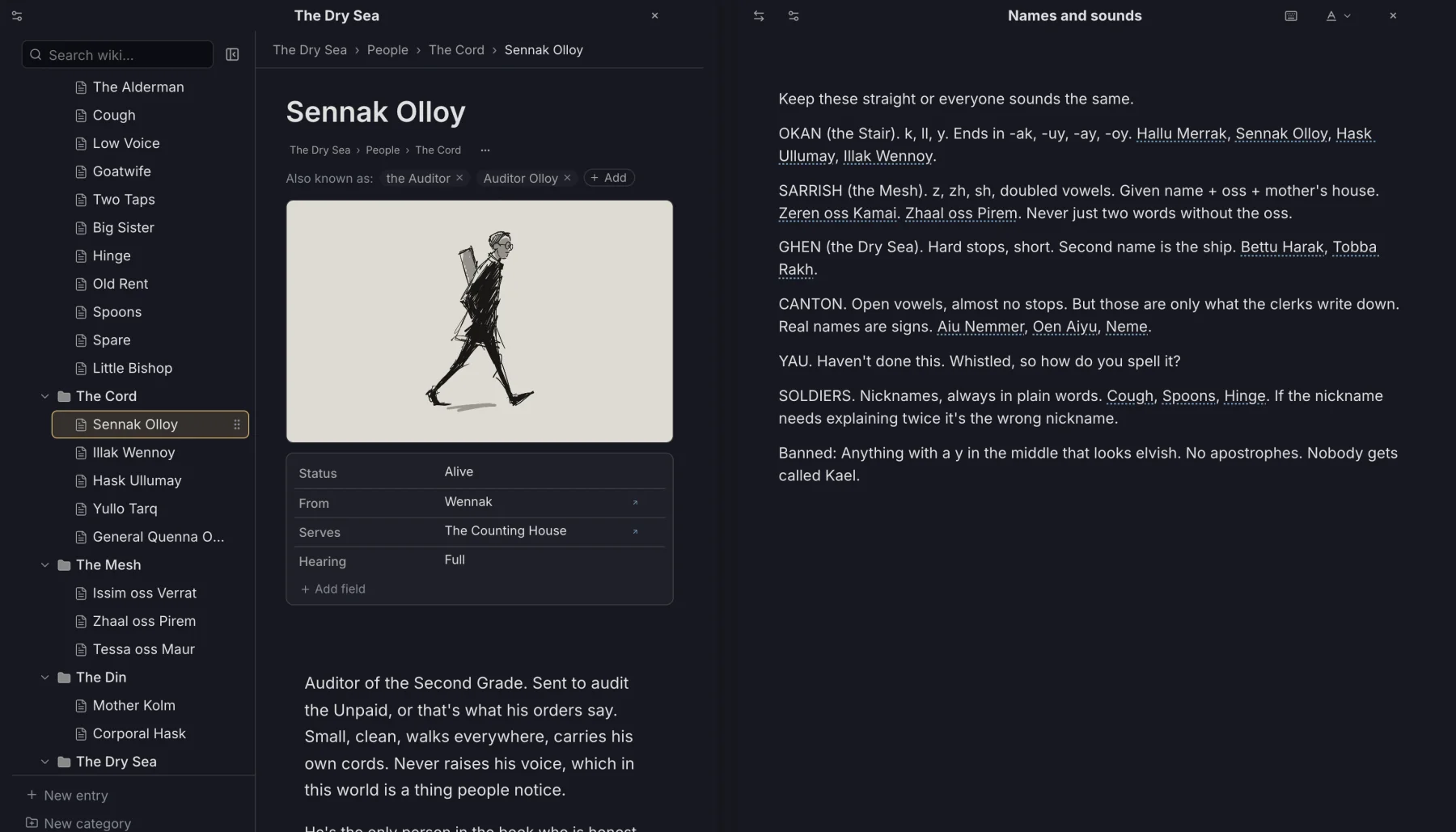
The Dry Sea’s naming note is seven lines long. Highland names end in -ak, -uy, -ay or -oy. Delta names are a given name, then “oss”, then the mother’s house. People from the sea take their ship as a second name. Soldiers go by nicknames in plain words, and if one needs explaining twice, it’s the wrong nickname.

Then think of the reader, who meets these names by eye. Start your main characters’ names with different letters, keep them sayable, and go easy on apostrophes.

Naming rules for five invented languages in a note, open beside a character’s wiki entry in BYOK Studio
The naming rules, open beside a character who follows them.

History that’s still causing trouble

A thousand years of kings is easy to write and hard to use. The history worth having is whatever someone in the story is still angry about, still paying for or still lying about.

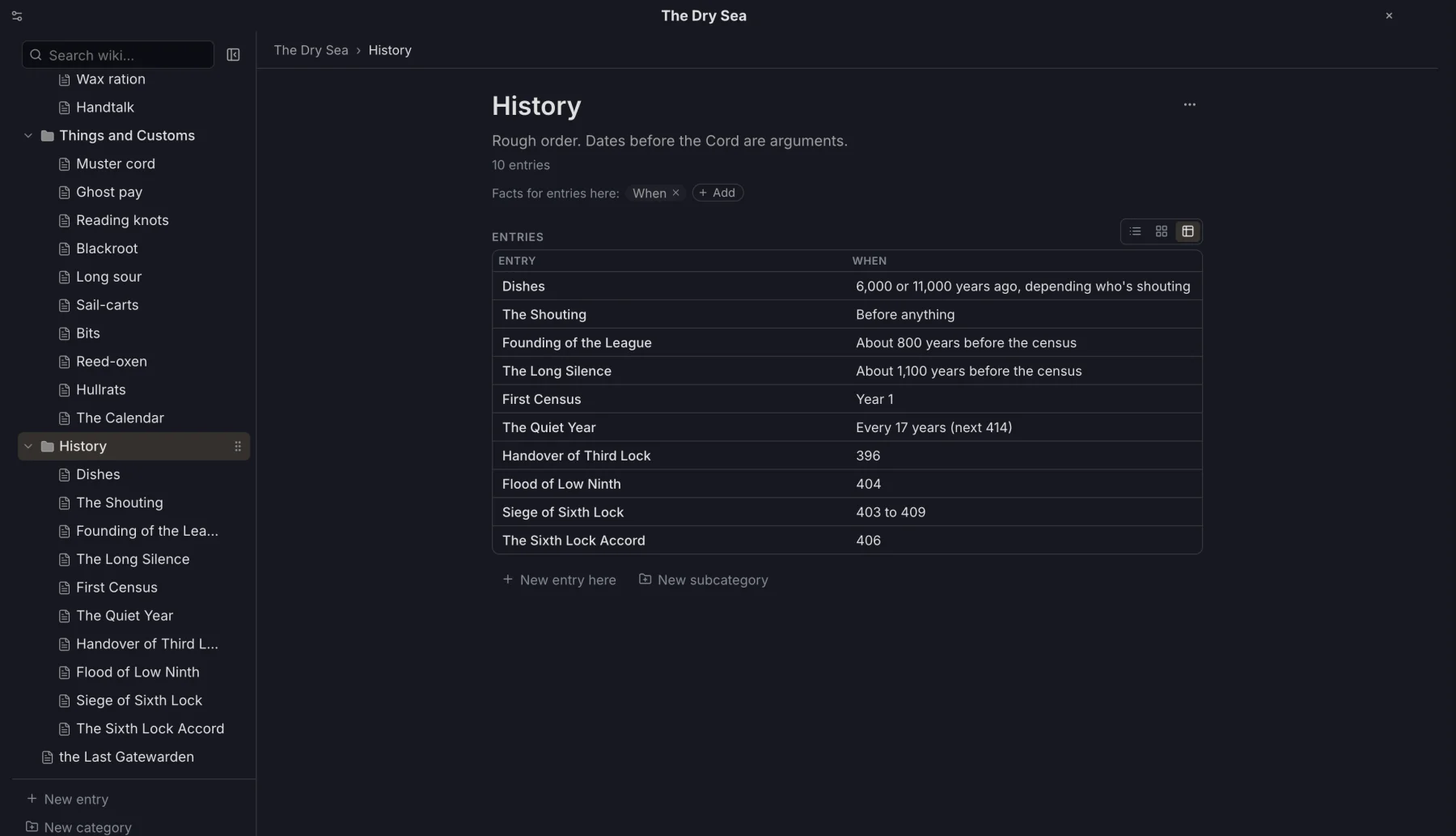
Let people disagree about it, and let it get vaguer with age. The Dry Sea’s oldest event is dated “6,000 or 11,000 years ago, depending who’s shouting”.

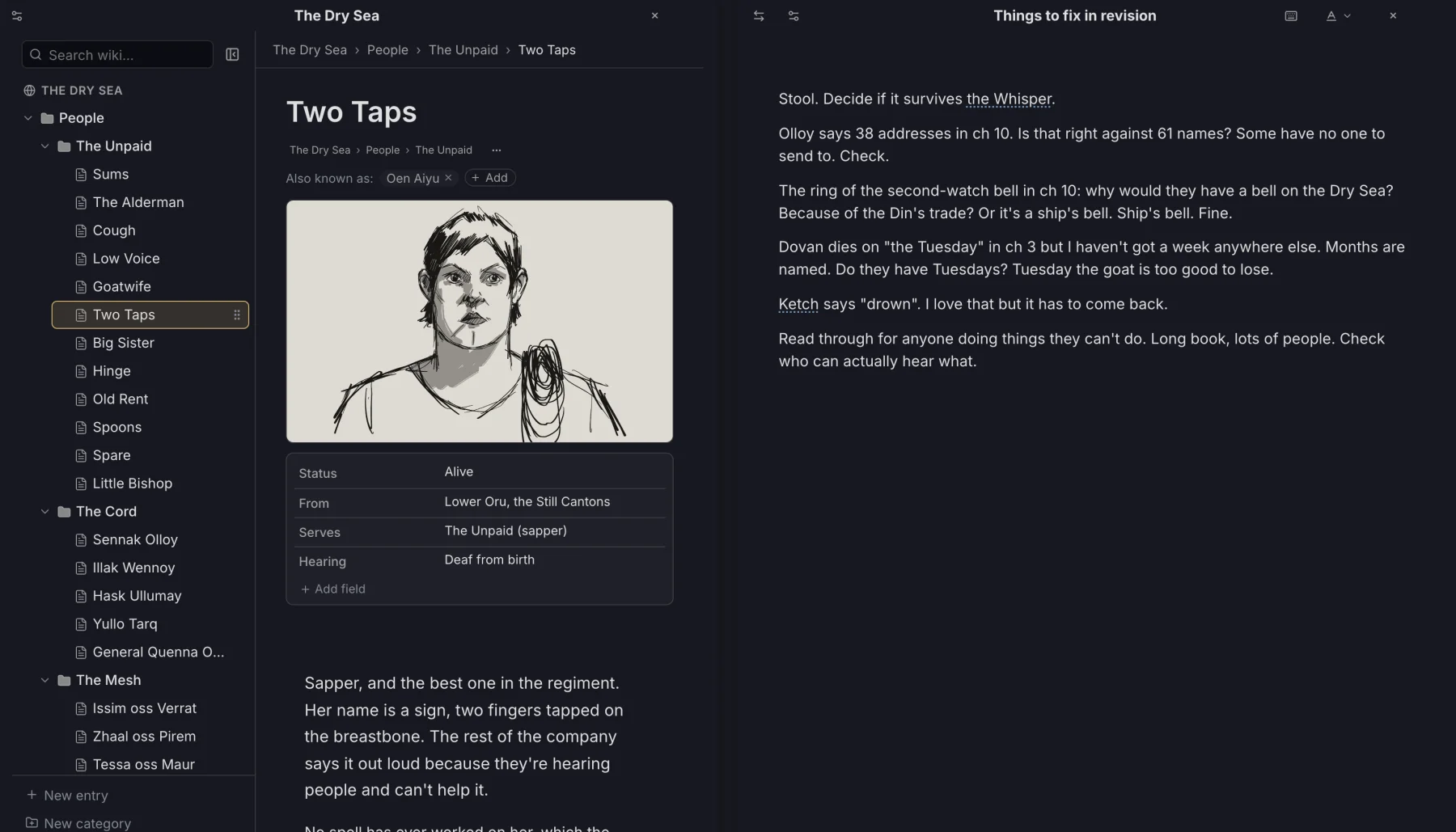
Settle the calendar early, though, because weeks and months turn up in dialogue from chapter one. A line in the Dry Sea’s revision notes reads, “Do they have Tuesdays?”

A History category in a worldbuilding wiki shown as a table of events and when each happened
Ten events and one fact for each: when.

How much worldbuilding is enough?

It’s possible to build a world for years and never write the story, and it’s enjoyable enough that you might not notice. A better question than “how much” is what the next scene needs, and what would be expensive to change once it’s written.

Settle before you draft

The rule of your magic or technology, and its limits. How long it takes to travel between the places in the plot. The calendar. How names work. These reach every chapter.

Sketch in a line or two

The powers, and what each one wants. The history people still argue about. What a month’s work pays. Enough to write from, and loose enough to change.

Invent when a scene asks

Everything else: far countries, old dynasties, what’s for dinner. When a scene needs an answer, make one up, and write it down the same day.

The Dry Sea’s wiki has a category called Elsewhere, for places the story doesn’t go. Its note reads, “Stubs. Don’t get lost in these.”

How to keep a fictional world consistent

Every invented fact is a promise to the reader, and long books break them all the time. George R. R. Martin’s A Clash of Kings has a horse that changes sex partway through.

The usual fix is a story bible: one place that holds every settled fact about the world. Whatever you keep yours in, four habits do most of the work.

One entry per thing

Each person, place and rule gets one home, with every name it goes by. “Sennak Olloy” and “the Auditor” should lead to the same entry.

The same facts for every entry of a kind

Record the same things about every person, and choose the ones your plot turns on. Everyone in the Dry Sea has a Hearing fact, because the magic works by sound.

Keep the page and the plan apart

A fact is fixed once it’s on the page. Until then it’s a plan, and you can change it freely.

Know where every name appears

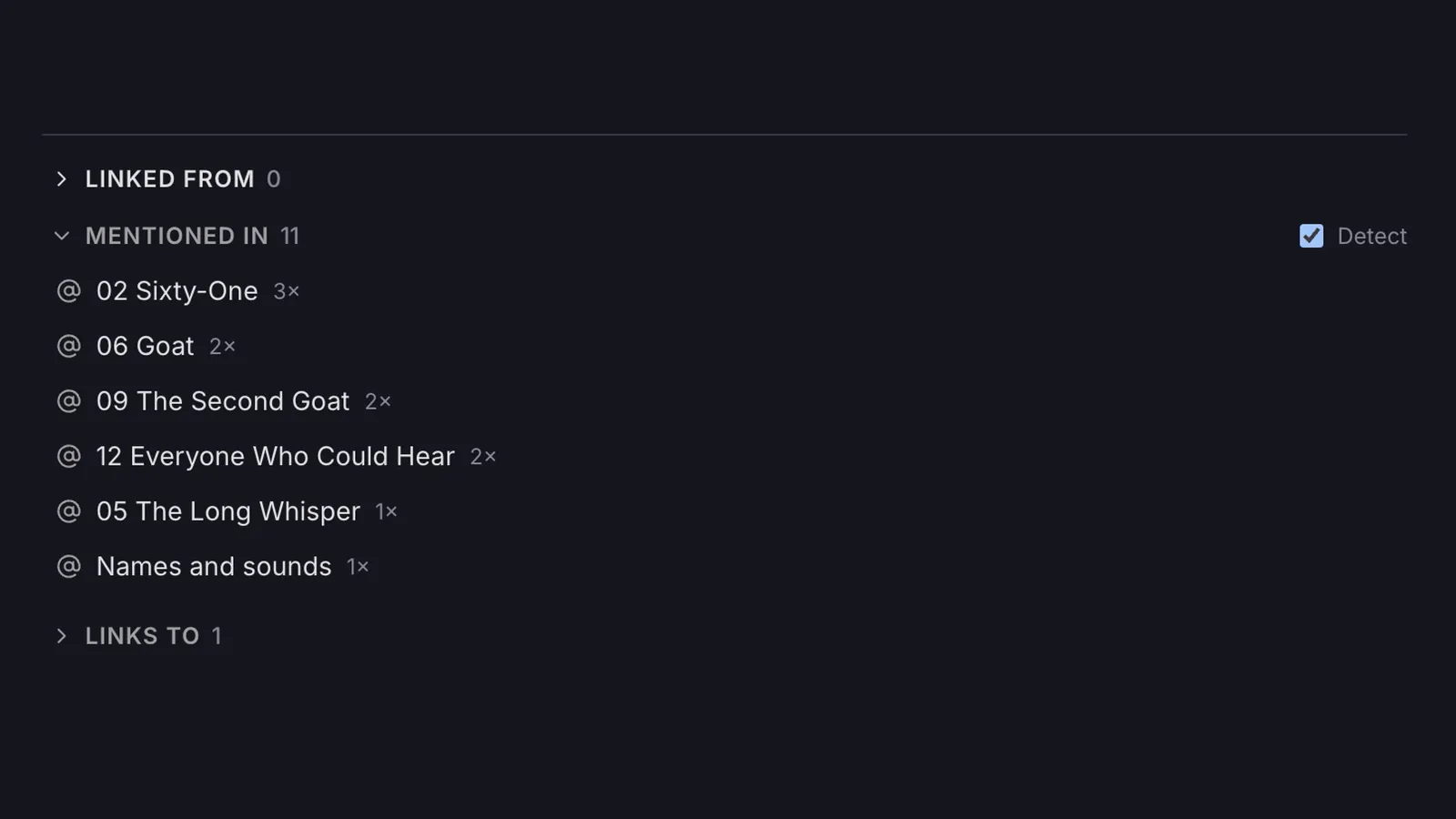
When a fact changes, the question is which chapters to reread. If you can list every chapter that mentions a character, a continuity check takes minutes.

A list of things to fix in revision, open beside the wiki entry for a character who has been deaf from birth
A list of doubts, open beside the entry it’s worried about. Two Taps has been deaf from birth.

Worldbuilding templates: make your own

Search for a worldbuilding template and you’ll find long forms with a blank for everything: climate, exports, religion, cuisine, heraldry. They’re tempting, and mostly a way to fill in facts no scene will ever ask for. Someone else’s template also can’t know what matters in your world. No stock character sheet has a line for how well a person can hear.

A better template is the one you make in ten minutes: three or four facts for each kind of thing, chosen because your plot depends on them. Add another when you catch yourself looking up the same thing twice. These are the Dry Sea’s.

People

StatusFromServesHearing

Places

RegionHeld byKnown for

Peoples and powers

HomelandTongueStands with

History

When

A space opera might track homeworld, allegiance and augmentations. A Regency romance might track income, title and who has been seen with whom.

What this looks like in BYOK Studio

We built Studio’s wiki around those habits. Facts are set once on a category, so every entry in it gets the same ones. When a name from the wiki turns up in a chapter, Studio marks it with a soft underline, without you linking anything. And every entry lists the chapters that mention it.

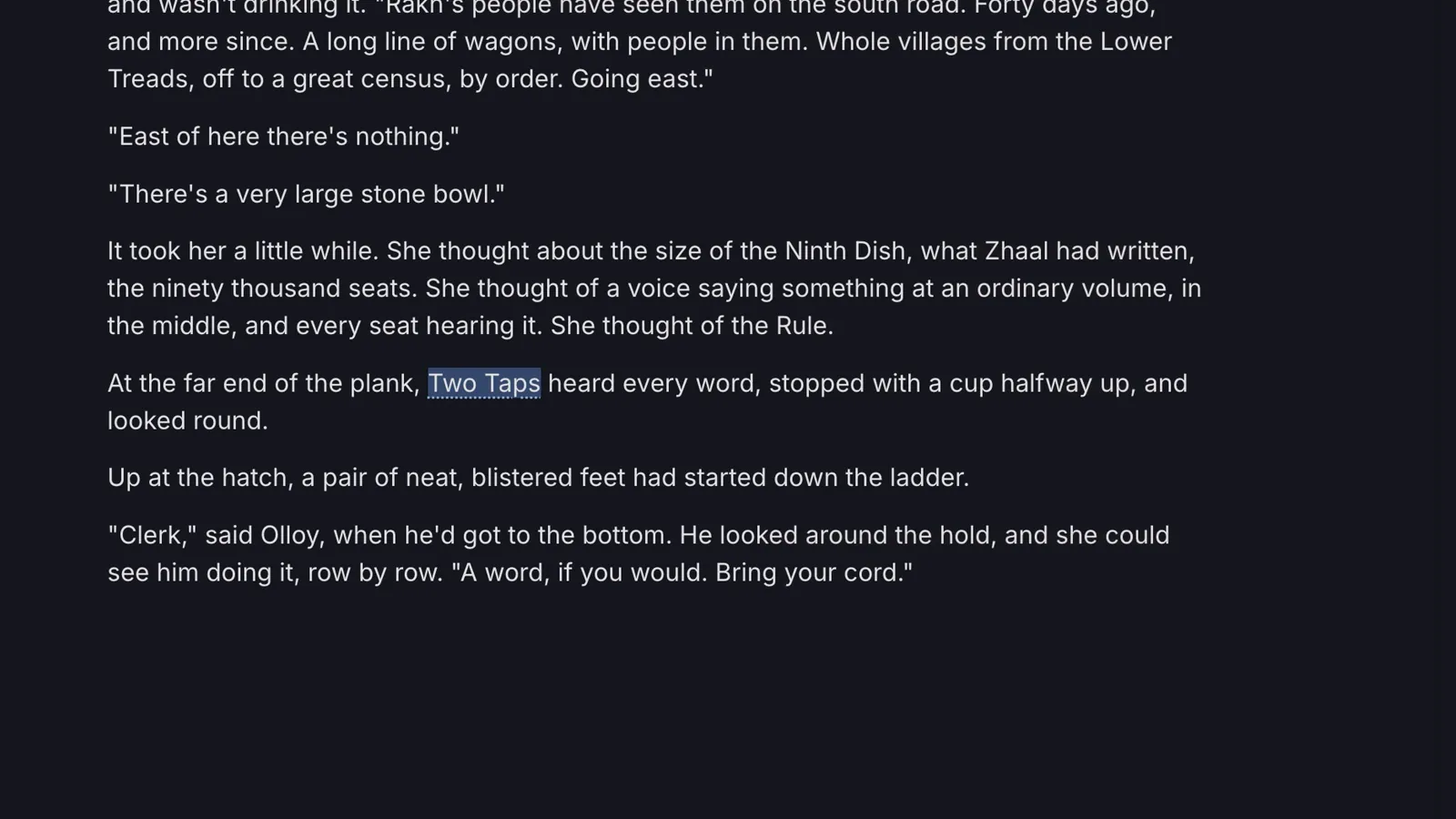
One chapter of the Dry Sea has a planted mistake: a woman who has been deaf since birth overhears a secret from across a bar. Studio doesn’t catch that for you, because it doesn’t know who can hear. It knows where her name is, so there are five chapters to check and you don’t have to reread the book.

The Mentioned in list on a BYOK Studio wiki entry, showing each chapter and how many times
Every chapter that mentions this entry, and how many times.
A chapter in BYOK Studio with the sentence containing the continuity mistake highlighted
“Two Taps heard every word.” She’s never heard a sound in her life.

See everything in Studio

Worldbuilding questions worth asking

Prompts for when you’re stuck, and not a checklist to complete. The useful answers are the ones that change what somebody does.

The land

  • What does the land force people to do?
  • Where does the water come from, and who controls it?
  • What’s the hardest journey most people will ever make?
  • What do maps of this place get wrong?

The people

  • Who’s in charge, and who actually gets things done?
  • What do people here consider rude?
  • What do they argue about among themselves?
  • How do they say goodbye to their dead?

Power and money

  • What does a month of ordinary work pay?
  • Who’s owed something they’ll never get?
  • What’s against the law, and who gets away with it?
  • What would a clerk know that a king wouldn’t?

History

  • What happened that everyone still argues about?
  • Who tells that story differently, and why?
  • What’s left standing from before?
  • What does everyone believe that isn’t true?

Magic or technology

  • What can it not do?
  • What does it cost, and who pays?
  • How would a careful person protect themselves from it?
  • What everyday job does it quietly do?

Names and language

  • Which sounds does this language never use?
  • How is a full name put together?
  • What do people call someone they don’t respect?
  • What do outsiders always get wrong about it?

Then ask three more of every answer. Will the reader ever see it? Would the plot change if it were different? Can it wait? For a far longer list, see Patricia C. Wrede’s fantasy worldbuilding questions, which cover seven areas in detail.

The best worldbuilding tools, compared

Worldbuilding software splits into two groups: websites built around the world itself, often for tabletop games, and writing apps that keep the world beside what you’re writing, whether that’s a novel, a script or something else. We make one of these, so weigh that as you read.

Two questions narrow it down. Is the world for something you’re writing, or for a game you’re running? Tools built for tabletop campaigns are strong on maps and sharing with players, and usually leave the writing to another app. And do you want your world in files on your own computer, or on a worldbuilding website you sign in to?

Campfire

Free with limits. $12 a month, or buy modules for life.

Writers who like a dedicated module for each kind of thing.

It has modules for characters, languages, religions, magic and more, and one for the manuscript. The free plan limits each module: 10 characters, 2 maps and 25,000 manuscript words.

World Anvil

Free for two public worlds and 42 articles. Paid from $7 a month.

Tabletop campaigns, and worlds you want to publish online.

A large worldbuilding website with a template for nearly everything. Private worlds and the manuscript editor are on paid plans.

Kanka

Free with unlimited entries. Premium from $4.99 a month.

Game masters who want a generous free plan.

Online only and built for tabletop campaigns, so there’s no manuscript editor.

LegendKeeper

$9 a month, after a 14-day trial.

Wikis and interactive maps kept together.

Well suited to tabletop campaigns, and it works offline in the browser. You’d write your manuscript somewhere else.

Obsidian

Free. Sync from $4 a month.

People who enjoy setting up their own system.

A general notes app that links plain text files on your computer. You build the worldbuilding structure yourself, often with plugins.

Notion

Free for one person. Plus is $10 a month.

People who think in databases.

A general workspace where each kind of thing can be a database with its own fields. It’s online first, and the manuscript usually lives somewhere else.

Scrivener

$59.99 once, per platform.

Writers who already draft in it.

A manuscript app with a research folder, links between documents and custom fields. It isn’t a wiki, so finding where a name appears means searching for it.

Obsidian for worldbuilding. It’s free, your notes are plain files, and linking two notes takes two brackets. It knows nothing about stories, though. Categories, facts and timelines are yours to build, usually with community plugins.

Maps. For drawing them, Inkarnate (free for three maps) and Wonderdraft ($29.99 once) are built for exactly that, and Azgaar’s Fantasy Map Generator, which is free, will make a whole continent to start from.

Documents and notebooks. A notebook or a folder of documents works too, up to a point. That point is usually the first time you need every scene a character appears in.

Prices checked November 2026. For writing apps more broadly, see the best book writing software.

Drafting away from your wiki

A wiki is also a good place to wander off into. You don’t need anything but Studio for any of this, but we like to draft on a BYOK, a small writing device we make. You bring your own keyboard, and there’s one small screen with nothing else on it.

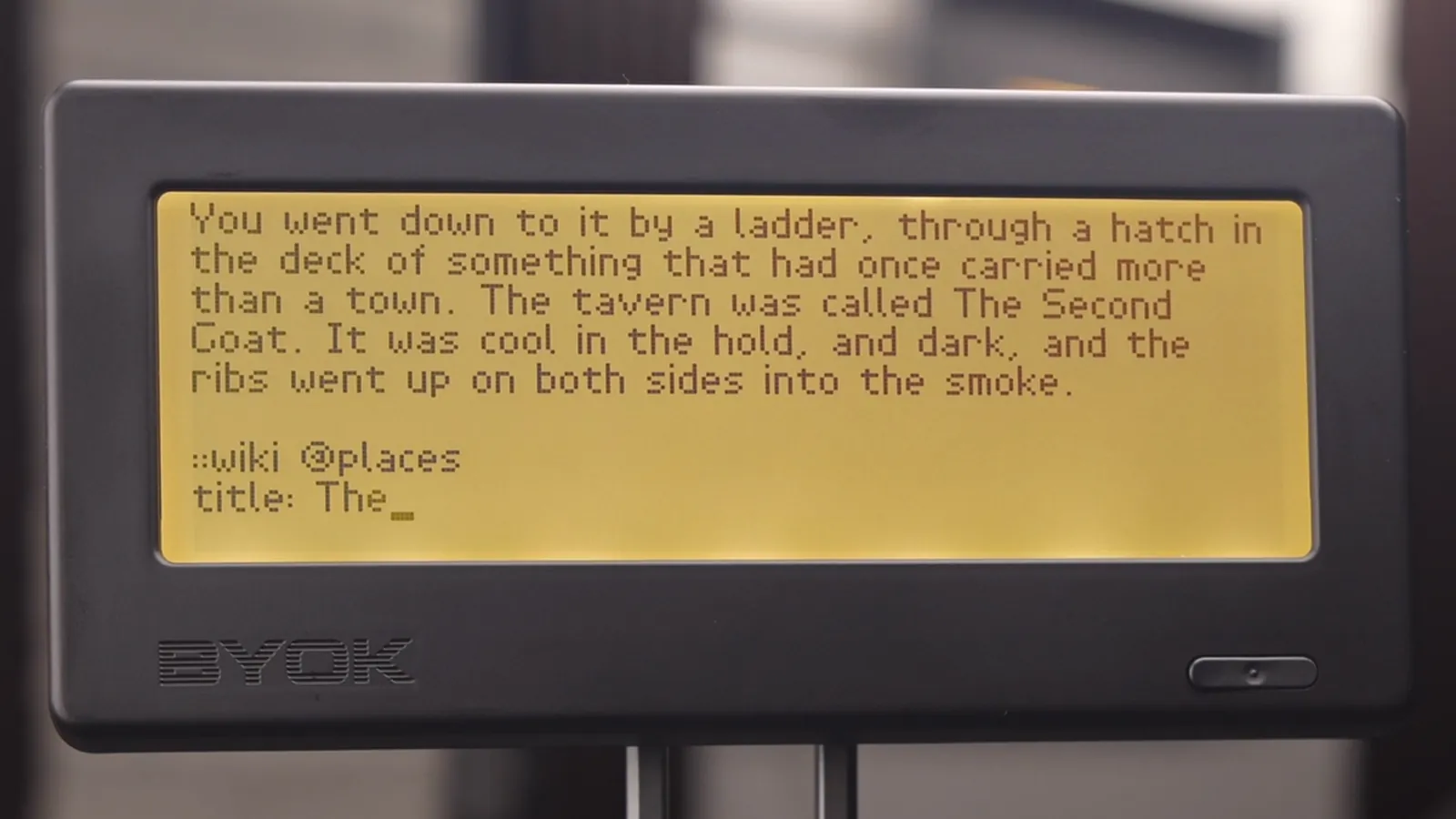
When you invent a tavern mid-scene, you can capture it without stopping: type ::wiki @places, its title and one line about it. When the device syncs, the chapter lands in Studio, and the tavern is an entry in your wiki.

The BYOK’s small screen showing a scene and a wiki capture being typed

See the BYOK

Worldbuilding FAQ

What is worldbuilding?

Worldbuilding is the work of inventing the place a story happens in: its land, history, peoples, powers and rules.

How do you start worldbuilding?

Either start with the big frame, such as the map and the history, and work down to a street, or start with one character in one room and invent only what each scene needs. Most writers fix a small frame first, then build outwards from the scenes they write.

How much worldbuilding do you need before you start writing?

Settle the things that reach every chapter and are expensive to change: the rule of your magic or technology and its limits, how long travel takes, the calendar, and how names work. Almost everything else can be invented when a scene asks for it, as long as you write it down.

Do you need a map to build a fantasy world?

Not to begin. A list of places with what’s next to what, who holds each one and how many days lie between them is enough to write from. Draw or commission the map once the story has stopped moving things around.

What is a story bible?

A story bible is one place that holds every settled fact about a fictional world: people, places, rules, history and timeline. Writers use it to keep long books and series consistent.

What is the best worldbuilding tool for writers?

It depends on what you’re making. If you’re writing, whether that’s a novel, a script or a series, a tool that keeps the wiki beside the writing saves the most work, such as BYOK Studio or Campfire. If you’re running a tabletop campaign, World Anvil, Kanka and LegendKeeper are built around that.

Is there a free worldbuilding app?

Yes. BYOK Studio’s desktop app is free on Mac, Windows and Linux with no account, and it includes the wiki. Kanka has a free plan with unlimited entries, Obsidian is free, and Campfire and World Anvil have limited free plans.

How do you keep a fictional world consistent?

Keep one entry for each person, place and rule, and give entries of the same kind the same facts. Then use a tool that shows every chapter mentioning a name, so that when a fact changes you know which chapters to check.

Bring your world into BYOK Studio

The wiki, outlines, cards, grid and manuscript are all free in the desktop app, with no account. Syncing is the Premium part.

Hear about new Studio features

Studio is in active development and regularly updated. Get an email when new features land, plus new writing guides and Studio offers.

Unsubscribe anytime.